What Is Free To Watch At Las Fallas In Valencia?
A plain answer to what costs nothing at Las Fallas: the mascletà, the plantà, the Ofrenda, the Cremà and the street fallas, plus which parts are ticketed.
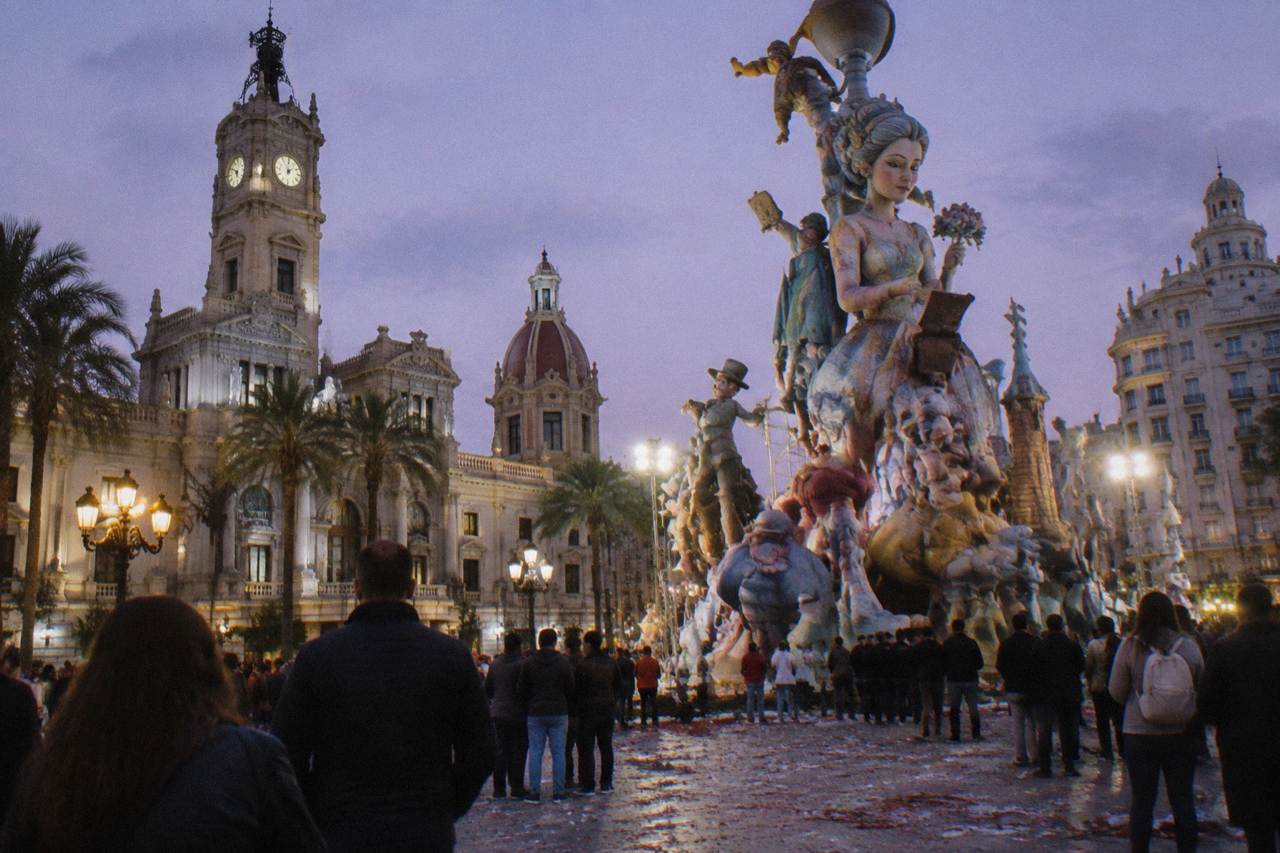
Las Fallas is the one week of the year when Valencia's streets stop being streets and start being stages. Giant satirical monuments, the ninots, go up on corners across every neighbourhood, fireworks crackle at two in the afternoon, and on the final night the whole thing burns. The festival runs a fixed annual pattern from 15 to 19 March, with the daily mascletà starting on 1 March, and the striking thing for a visitor on a budget is how much of it simply happens in public space, free to anyone standing there. Not all of it: some parts are fenced and ticketed, and knowing the line between the two is the difference between a free festival and an expensive surprise.
What Is Free To Watch At Las Fallas In Valencia?
Almost the entire spectacle of Las Fallas is free to watch from public streets: the fallas monuments themselves, the daily mascletà at 14:00 at Plaza del Ayuntamiento, the plantà on the night of 15 to 16 March, the Ofrenda de flors on 17 and 18 March, the nightly street fireworks, and the Cremà on the night of 19 March. Only entering Special Section monument enclosures and the Ninot Exhibition is ticketed, with no amounts published on this site.
The distinction that matters is between the festival as a street event and the festival as a ticketed venue. The street event is the overwhelming majority of it. More than the monuments themselves, Fallas is a rhythm: the city centre reorganises itself around a timetable of noise, flowers and fire, and nearly all of that timetable plays out on open pavement where nobody collects a euro.
The ticketed parts are specific and easy to avoid. The Ninot Exhibition, where the figures that will top the monuments are displayed and voted on before the festival, charges for entry. And the biggest, most elaborate monuments in the Special Section stand inside fenced enclosures during the main days, and walking inside those fences costs money. Standing on the public side of the fence, three metres away, costs nothing. No ticket amounts are published for either, because the official pages do not state them.
If you want the festival framed by a local before the noise starts, the free walking tours listed on this site, 36 of them across GuruWalk and freetour.com, run year round, and several meet at landmarks that sit inside the festival's footprint. The Free Monumental Tour of Valencia, a freetour.com listing rated 9.4 out of 10 across 280 freetour.com reviews, meets at the Lonja de la Seda, the historic silk exchange that is itself free to enter on Sundays and public holidays, EUR 2 otherwise. A walk like that costs nothing upfront: you reserve a free spot and tip the guide what the walk was worth at the end.
The full picture of the festival, including the monuments, the neighbourhood parties and the food stalls, is laid out in the complete Las Fallas guide, and the wider list of cost-free sightseeing is in what to do in Valencia for free.
Which Fallas Events Are Free In The Street?
The free events are the ones with no fence: the fallas monuments standing in their streets all week, the plantà when they are raised overnight on 15 to 16 March, the daily mascletà, the Ofrenda de flors flower offering on 17 and 18 March, the street parades, the nightly fireworks, and the Cremà on 19 March. Every one of these is watched from public ground and no ticket exists for them.
Start with the monuments, because they are the easiest free thing people overlook. From the plantà onwards, hundreds of ninot-filled fallas stand in the streets of every neighbourhood, and walking a route between them is a self-guided, cost-free gallery of satire, craft and local politics. The smaller neighbourhood fallas are often the more charming ones, and they are entirely public. There is no official street-art-style route map for the festival published by the city that this site can point to, but the monuments cluster densely in Ciutat Vella, Ruzafa and El Carmen, and wandering between them is the standard way to see them.
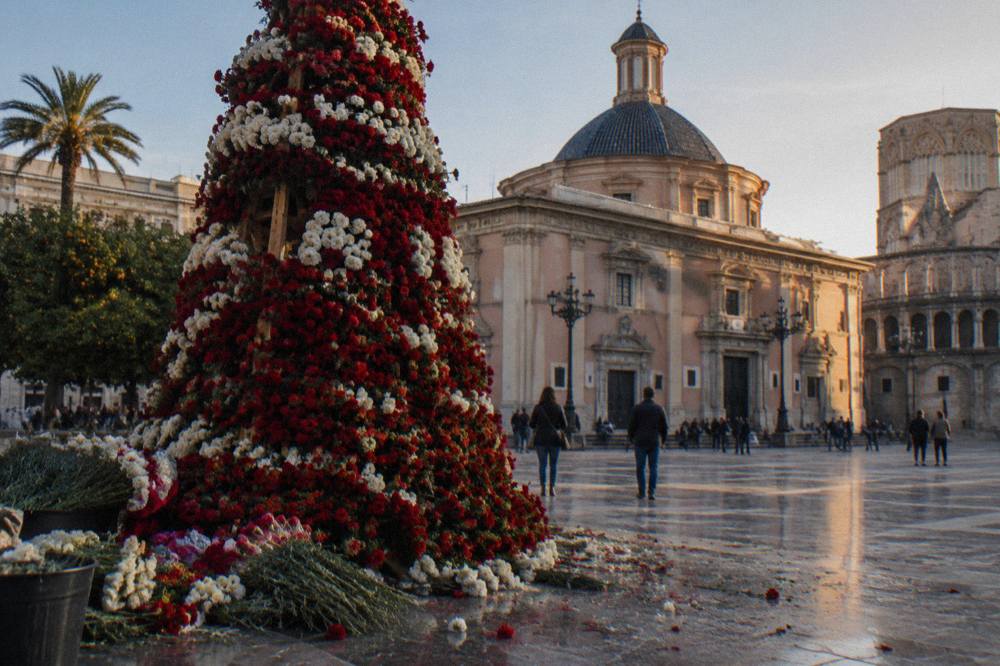
The Ofrenda de flors is the emotional centre of the festival and one of the best free spectacles: the falleras and falleros of every casal process through the streets over two days, 17 and 18 March, carrying flower bouquets that are built layer by layer into a towering floral mantle on the frame of the Virgin by Plaza de la Virgen. The processions run for hours and can be watched from any point along the route. It is slow, crowded and genuinely moving, and it costs nothing.
Then there is everything that happens after dark. Fallas week is loud at night by design: street bands, neighbourhood casals open late, and firecrackers going off in the streets as the correfoc-style street celebrations run. The big structured pyrotechnic displays, the castells de focos, the aerial fireworks, are fired from the old riverbed of the Turia and are watched free from the banks. The Turia Gardens guide covers the ground.
One caution: this site's Free Things To Do In Valencia directory treats the festival's free status as conditional where it is conditional. Fallas in the street is free. Fallas behind a fence is not.
When And Where Does The Mascletà Happen?
The mascletà fires daily at 14:00 sharp, from 1 March through 19 March, at Plaza del Ayuntamiento in the city centre. It is a daytime gunpowder concert of coordinated bangers rather than a fireworks display, it lasts a few minutes, and watching it from the surrounding streets is free, with no ticket and no reserved area for the general public.
The mascletà is the part of Fallas that Valencians themselves treat as the main event, and it is the single most accessible free spectacle in the city's calendar. From 1 March, every single day at two in the afternoon, a pyrotechnic crew wires a sequence of thousands of thundering bangers into the square, and the result is less a firework display than a percussion piece: rhythm, build, and a final section called the terretela where the noise becomes physical, a pressure you feel in the chest and the pavement. It lasts minutes, not hours, and then the crowd disperses and the square goes back to being a square.
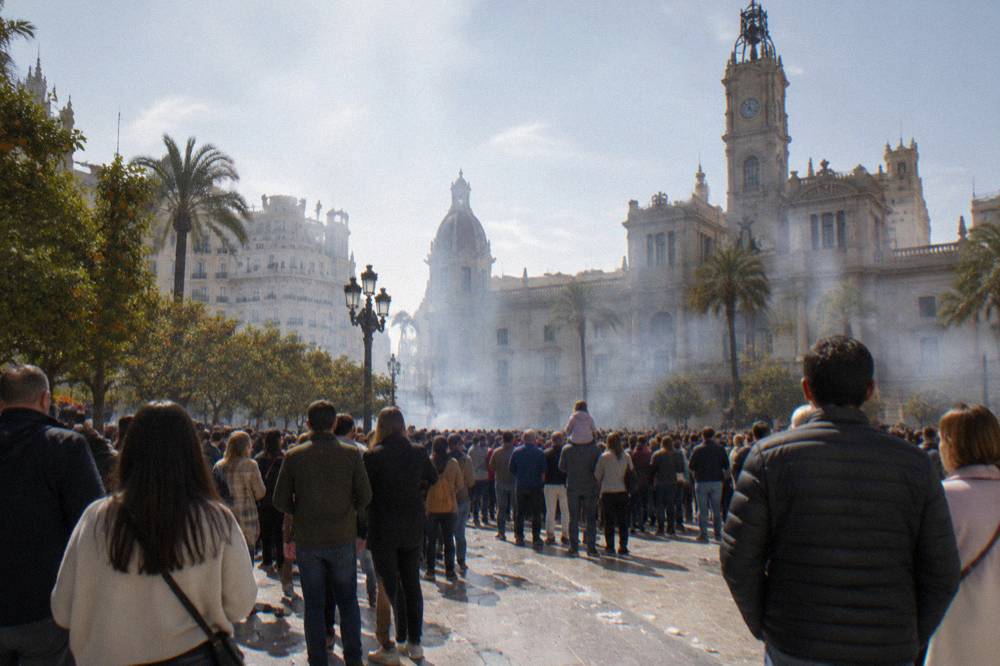
Practical notes that are safe to state: arrive early, because the plaza and its side streets fill well before 14:00, and the sound is the point, so people with sensitive hearing or small children commonly watch from further back or plug ears. This site publishes no reserved-seating claims and no official crowd figures, because none are confirmed. What is confirmed is the pattern: 1 to 19 March, 14:00, Plaza del Ayuntamiento, free.
The square sits at the heart of the old town, and a walk that starts nearby is the Free Tour Valencia Essentials, a GuruWalk listing rated 4.73 out of 5 across 5,030 GuruWalk reviews, 2 hours 30 minutes, meeting at Plaça de la Mare de Déu and running in English and Spanish. Meeting near the festival's ground zero makes it a natural warm-up for an afternoon mascletà.
What Is The Cremà And Can You Watch It For Free?
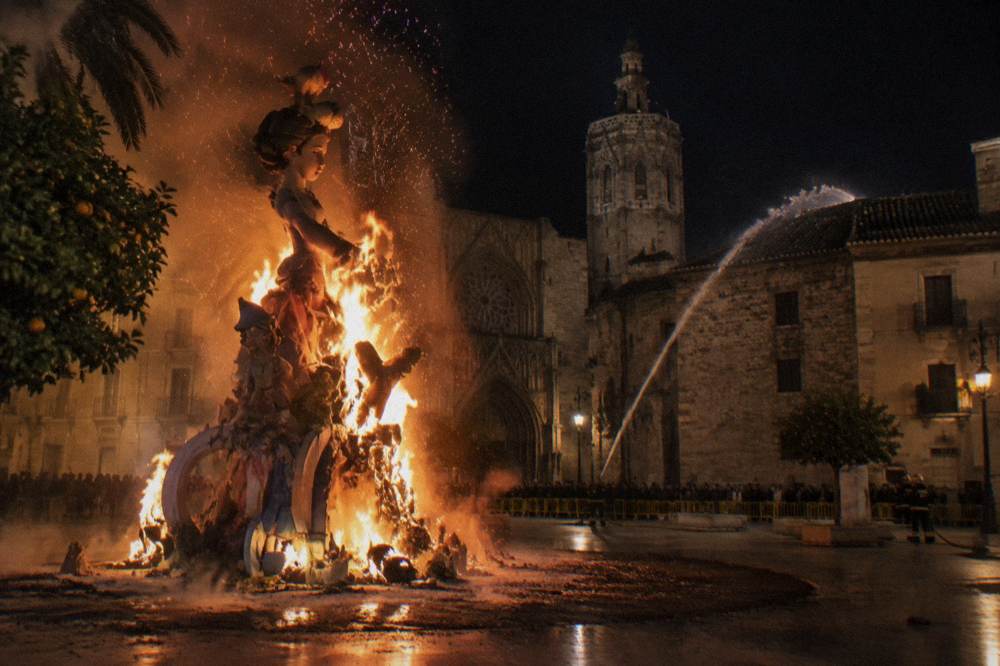
The Cremà is the closing night of Las Fallas, the night of 19 March, when the fallas monuments are set alight across the whole city at staggered times through the evening. It is free to watch from public streets everywhere, it is the festival's climax, and no ticket is sold for standing in a street while a monument burns.
The word means "the burning", and it is the whole logic of the festival made visible: a year of planning and construction, publicly incinerated in about twenty minutes. The smaller neighbourhood fallas burn first in the early evening, then progressively larger ones, and the largest monuments in the city centre burn last, late into the night. Fire crews drench surrounding facades and trees before each fire, the crowds stand behind cordons, and the fires are set one by one. A visitor can walk between several burnings in one night.
Two honest cautions. First, the smoke is heavy and the ash drifts for blocks; this is not a clean-sky event. Second, the night of 19 March is late, loud and extremely crowded, and the biggest bonfires draw the densest crowds of the entire year. Nothing about that is ticketed. It is simply a question of patience and street position.
The cathedral, a short walk from the central burnings, runs no cultural visit on 19 March: the cultural visit, EUR 12, EUR 6 reduced, is suspended that day along with 1 and 6 January, Palm Sunday, Good Friday, 9 October, 8 December and 25 December, per the cathedral's own admission page. The Miguelete bell tower is a separate EUR 3 ticket the cathedral ticket does not include, and the municipal Sunday free rule never applies to any of it. So if the Cremà sends you toward the old town's monuments, the free ones that week are the ones under the municipal regime: the Lonja, the Torres de Serranos and Torres de Quart climbs, L'Almoina and the Museu Faller, free on Sundays and public holidays only, 10:00 to 14:00 that day, EUR 2 otherwise, per the city's infociudad pages for the towers. The Serranos and Quart climbs also close in rain, fog or strong wind and without daylight, a real consideration on a March night.
Which Fallas Events Are Ticketed?
Only two parts of Las Fallas charge entry: the Ninot Exhibition, where the ninot figures are displayed and voted on before the festival, and the Special Section monument enclosures, the fenced areas around the largest, most elaborate fallas during the main days from 16 to 19 March. No ticket prices for either are published on this site, and everything outside those fences is free.
The Ninot Exhibition is an indoor exhibition held in the weeks before the festival, where the public votes on which ninot figures escape the flames, the prized indultats. It is a genuine museum-quality visit and it charges admission. The Special Section enclosures are the other paid piece: the biggest monuments, the ones that cost their casals the most to build, stand inside fenced compounds during the festival's peak days, and walking inside the fence to see them at close range is a paid experience. The fence is a few metres out from the monument, and the view from the public side is of the same artwork.
Everything else on the Fallas calendar is open air and open access. To keep the boundary clear:
| Fallas element | Free or ticketed | How to see it |
|---|---|---|
| Street fallas monuments, all sections from the public side | Free | Walk any neighbourhood, any time from the plantà |
| Daily mascletà, 1 to 19 March, 14:00 | Free | Stand in or near Plaza del Ayuntamiento |
| Plantà, night of 15 to 16 March | Free | Watch monuments being raised in the streets overnight |
| Ofrenda de flors, 17 and 18 March | Free | Watch the processions along the route |
| Night aerial fireworks from the old riverbed | Free | Watch from the Turia banks |
| Cremà, night of 19 March | Free | Stand behind the cordons at any burning |
| Ninot Exhibition | Ticketed, no amounts published | Paid entry, held before the festival |
| Special Section monument enclosures, 16 to 19 March | Ticketed, no amounts published | Paid entry inside the fence |
One schedule note that is often missed: the festival's fixed pattern is mid-March, mascletà daily at 14:00 from 1 March, Cremà on the night of 19 March, and this site publishes nothing beyond that pattern. No programme for a future year's Fallas exists yet to quote, and any page selling "official 2027 tickets" ahead of a published programme is not a source this site endorses.
Where Do The Best Free Viewpoints Sit?
The best free ground is the Turia's old riverbed banks for the night fireworks, the side streets off Plaza del Ayuntamiento for the mascletà, and the residential neighbourhoods of Ruzafa and El Cabanyal for the smaller monuments and the neighbourhood burnings, all public, all free, and all reachable on foot or by the city's ordinary transport.
The riverbed point deserves emphasis. The aerial fireworks of Fallas week are fired from the dry bed of the old Turia river, and the sloping banks on both sides are public park, free to sit on, with the bursts directly overhead. It is an unusually good free viewing arrangement, and it exists because Valencia buried its river and turned the bed into a park. The Ruzafa guide covers the neighbourhood whose streets fill with mid-size fallas and late-night casal life.
For the Cremà itself, the counterintuitive advice is to leave the biggest central bonfires to the crowds and follow the smaller neighbourhood burnings, where the atmosphere is local, the fires are close enough to feel, and the streets are walkable. El Cabanyal, the former fishing quarter by the sea, burns its fallas a short walk from the beach, and the Valencia beaches guide covers the coast it sits on.
If you want the old town mapped before the crowds arrive, the Free Monumental Tour of Valencia is the natural fit: it is the freetour.com listing that meets at the Lonja de la Seda, 1 hour 45 minutes, English and Spanish, rated 9.4 out of 10 across 280 freetour.com reviews. Like every walk on this site it is free, pay what you want: reserve a free spot, walk, and tip the guide what the walk was worth.
A closing word on the festival's character. Fallas is not a spectator event that tolerates the public; it is a neighbourhood event that the public is invited into. The casals, the social clubs that build the monuments, are ordinary residents who spend a year fundraising, and the street parties around their fallas are open in the sense that the street is open. Standing at the edge of one with a drink bought from a kiosk is as close to the real festival as a visitor can get, and it costs the price of the drink.
Common Questions About Las Fallas Free Events
What Is Free To Watch At Las Fallas In Valencia?
The fallas monuments in the streets, the daily mascletà at 14:00 at Plaza del Ayuntamiento from 1 March, the plantà on the night of 15 to 16 March, the Ofrenda de flors on 17 and 18 March, the night fireworks from the Turia banks, and the Cremà on the night of 19 March. Only the Ninot Exhibition and the Special Section monument enclosures are ticketed, with no amounts published on this site.
Is The Mascletà Free To Watch?
Yes. The mascletà fires daily at 14:00 sharp from 1 to 19 March at Plaza del Ayuntamiento and is watched free from the surrounding streets. It is a daytime gunpowder concert, not a fireworks display, and it lasts minutes.
Can You Watch The Cremà Without Paying?
Yes. The Cremà on the night of 19 March is the public burning of the fallas monuments across the whole city, and every burning is watched from public streets behind cordons. No ticket exists for standing in a street while a monument burns.
Which Fallas Events Charge For Entry?
Two: the Ninot Exhibition, held before the festival, and the fenced enclosures around the largest Special Section monuments during the main days. No ticket prices for either are published on this site.
When Does Las Fallas Take Place Each Year?
The festival follows a fixed annual pattern in mid-March: the mascletà runs daily at 14:00 from 1 March, the main days are 15 to 19 March, and the Cremà closes the festival on the night of 19 March. This site publishes nothing beyond that fixed pattern.
Are The Fallas Monuments Themselves Free To See?
Yes, from the street. Hundreds of monuments stand in public streets from the plantà onwards and walking between them costs nothing. Only entering the fenced enclosures around the largest Special Section fallas is ticketed.